Piano Chords for Beginners: Learn Your First Chords
Learn six essential piano chords with clear notes, simple fingering, major and minor chord formulas, and a practical ten-minute routine.
Quick Answer
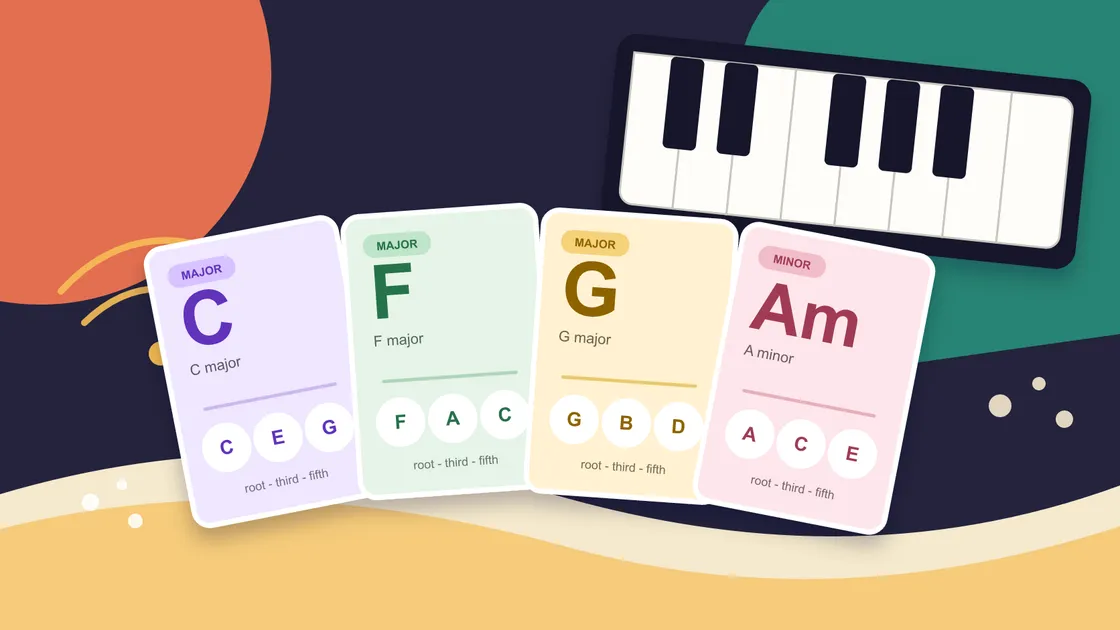
A piano chord is a group of notes played together. Beginners should start with three-note chords called triads. The first useful chords to learn are C major, F major, G major, A minor, D minor, and E minor. For a root-position chord, the right hand usually uses fingers 1-3-5 and the left hand uses 5-3-1. Practise one chord at a time, press all three notes together, and release without tension. Once each shape feels comfortable, practise slow changes such as C-F-G-C.
What Is A Piano Chord?
A chord combines notes to create harmony. While a melody usually moves from one note to the next, a chord supports the melody with several notes sounding at the same time.
The most useful first chords are triads, which contain three different notes:
- the root, which gives the chord its name
- the third, which helps make the chord major or minor
- the fifth, which completes the basic shape
For example, a C major chord contains C, E, and G. C is the root, E is the third, and G is the fifth.
These notes are not chosen randomly. C, E, and G are the first, third, and fifth notes of the C major scale. If scales are new to you, see Piano Scales for Beginners.
What Is The Difference Between Major And Minor Chords?
Major and minor triads use the same basic root-third-fifth structure, but the middle note changes.
- C major: C-E-G
- C minor: C-E flat-G
The E moves down by one half step to become E flat. That small change gives the chord a different quality.
You can also build triads by counting half steps:
- Major chord: 4 half steps from the root to the third, then 3 half steps to the fifth
- Minor chord: 3 half steps from the root to the third, then 4 half steps to the fifth
Beginners do not need to count every chord from scratch. Learn a few reliable note combinations first, then use the formula to understand why they work.
How To Read Piano Chord Symbols
Chord symbols are short labels often printed above lyrics or sheet music.
- C means C major
- F means F major
- G means G major
- Am means A minor
- Dm means D minor
- Em means E minor
A capital letter by itself normally means a major chord. A lowercase m after the letter means minor. Therefore, C and Cm are different chords.
You can learn chord symbols before reading full notation. However, How to Read Sheet Music for Piano Beginners will help you recognise chords when their notes are stacked on a staff.
Start With C Major
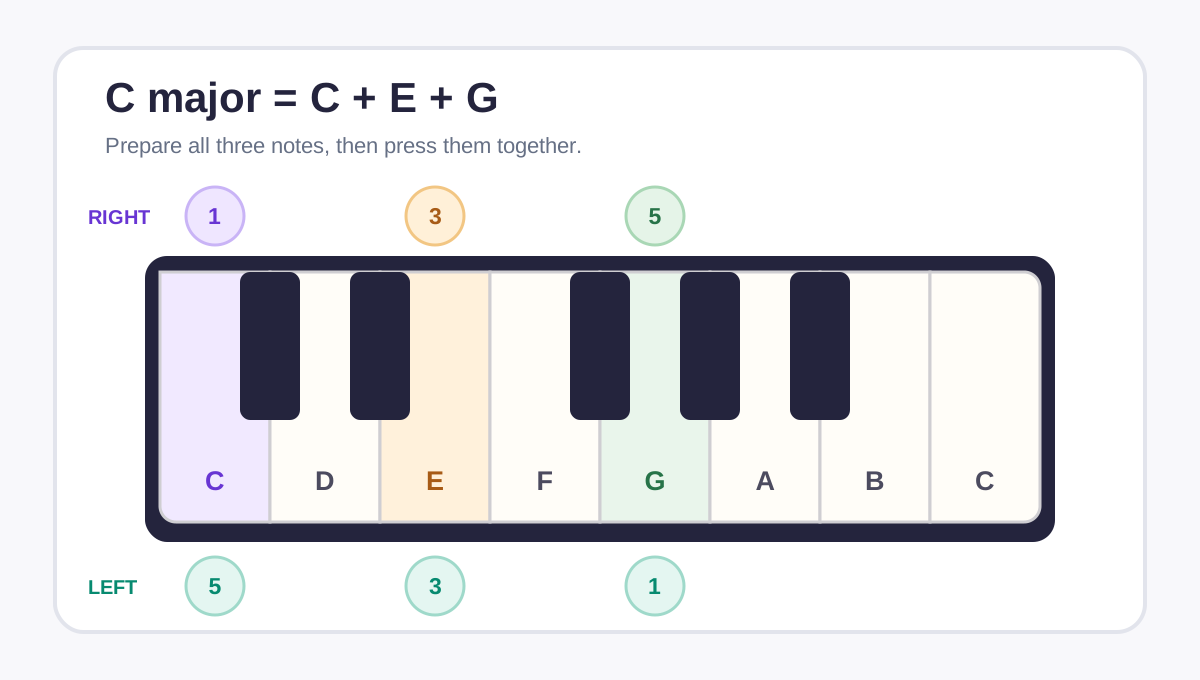
C major is the easiest first piano chord because it uses three white keys: C, E, and G.
Find C immediately to the left of a group of two black keys. From C, skip D and play E. Then skip F and play G.
Right-Hand Fingering
Use:
- thumb, finger 1, on C
- middle finger, finger 3, on E
- little finger, finger 5, on G
Left-Hand Fingering
Use:
- little finger, finger 5, on C
- middle finger, finger 3, on E
- thumb, finger 1, on G
Keep the hand rounded and the wrist flexible. Press C, E, and G together, listen to the chord, then release all three notes together.
If one note sounds later than the others, prepare all three fingertips on the keys before pressing. Do not solve the problem by pressing harder.
Six Beginner Piano Chords To Learn First
These six chords use only white keys and appear in many beginner-friendly chord patterns.
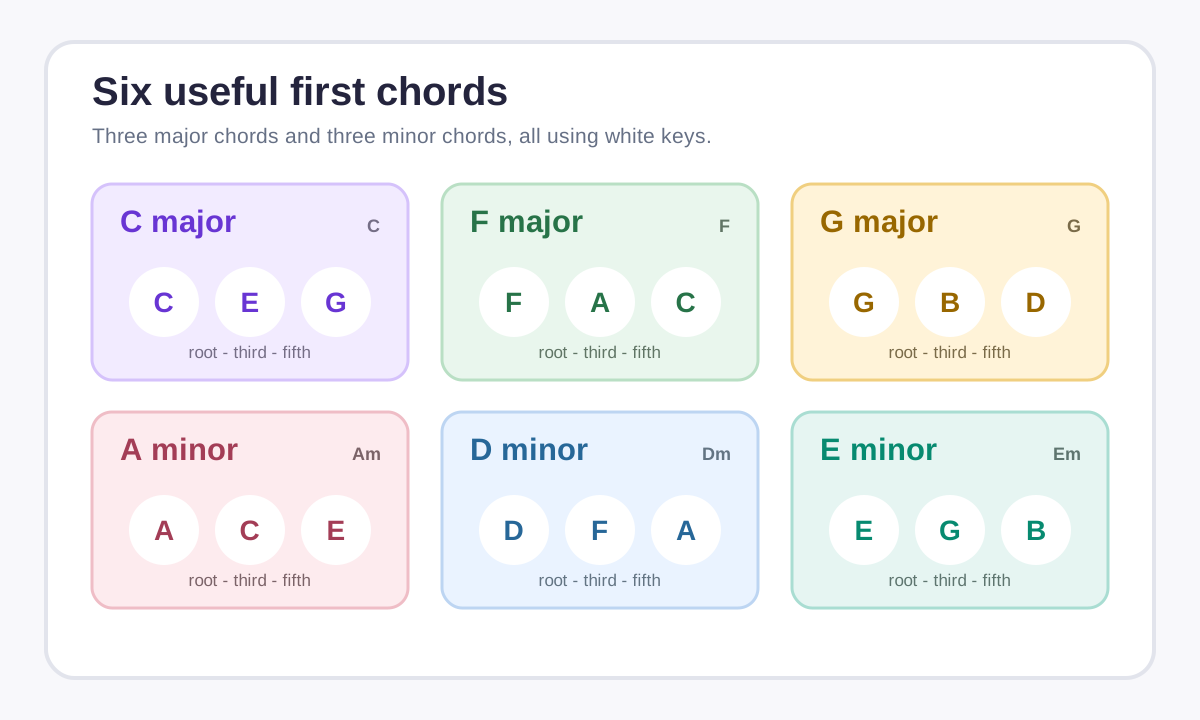
C Major: C-E-G
C major is a useful home chord in music based on C major. Start here because the shape is easy to see and remember.
F Major: F-A-C
F major uses the same skip-skip shape on white keys. Move the whole hand so the thumb or little finger begins on F.
G Major: G-B-D
The D is the next D to the right of B when the chord is played upward. Check the group of two black keys if you need help finding D.
A Minor: A-C-E
A minor uses the same white keys as part of the C major scale, but A is the root. It is written Am.
D Minor: D-F-A
D minor is written Dm. Keep the same relaxed root-position fingering and move the hand so it begins on D.
E Minor: E-G-B
E minor is written Em. It completes a useful first group of three major and three minor chords.
For all six root-position chords, beginners can start with right-hand fingers 1-3-5 or left-hand fingers 5-3-1.
How To Play A Chord Cleanly
Use this sequence for each new chord:
- Find the root. Say the chord name and locate its starting note.
- Find the other notes. Build the skip-skip shape without playing yet.
- Prepare all three fingers. Let the fingertips rest lightly on the correct keys.
- Press together. Listen for one coordinated attack rather than three separate notes.
- Hold and breathe. Keep the wrist and shoulders relaxed.
- Release together. Lift only enough to reset the hand.
Repeat the chord three to five times. Stop between repetitions if the fingering changes or the hand becomes tense.
Blocked Chords And Broken Chords
A blocked chord plays all chord notes at the same time. A broken chord plays the same notes separately.
Using C major:
- Blocked: C, E, and G together
- Broken upward: C-E-G
- Broken up and down: C-E-G-E-C
Blocked chords train coordination and even contact. Broken chords help you learn the individual notes and distances inside the shape.
Practise the blocked version first. Then play the broken pattern slowly without changing the fingering.
How To Practise Changing Chords
Knowing individual chords is only the first step. Songs require you to move from one chord to another without losing the beat.
Start with two chords:
- Play C major and hold it for four counts.
- Release and move to F major.
- Hold F major for four counts.
- Move back to C major.
Pause as long as necessary at first. Accuracy is more important than maintaining a continuous rhythm.
Next, practise this four-chord exercise:
C-F-G-C
Play each chord once and count four steady beats before changing. When the movement becomes reliable, reduce the pause between chords.
Another useful sequence is:
C-G-Am-F
This requires larger root-position movements, so practise it with one hand and at a slow tempo. Smoothness comes from preparing the next shape early, not from moving suddenly.
What Are Chord Inversions?
A chord inversion uses the same notes in a different order.
C major can appear as:
- Root position: C-E-G
- First inversion: E-G-C
- Second inversion: G-C-E
Inversions let the hand move a shorter distance between chords. They are useful, but beginners should first recognise and play the root-position shapes accurately.
Once C, F, and G are comfortable, inversions are a sensible next step for smoother chord changes.
A Ten-Minute Beginner Chord Routine
Use this routine on its own or as part of the 15-Minute Piano Practice Routine for Beginners.
- Minutes 0-2: Play C major slowly with each hand separately.
- Minutes 2-4: Review F major and G major.
- Minutes 4-6: Review A minor, D minor, and E minor.
- Minutes 6-8: Practise C-F-G-C, one chord every four counts.
- Minutes 8-10: Use two or three chords in a beginner song or make your own short pattern.
You do not need to play all six chords every day. A focused session on two clean chord shapes can be more useful than rushing through the full set.
Common Beginner Chord Mistakes
Playing The Notes One After Another By Accident
Prepare all fingertips before pressing. Slow preparation makes a clean simultaneous chord easier.
Leaving Out The Middle Note
The third determines whether the chord is major or minor. Check the middle finger rather than listening only to the outside notes.
Flattening The Fingers
Use comfortably curved fingers so they do not touch neighbouring keys. The thumb can rest naturally on its side.
Holding Tension After The Chord Sounds
Once the keys are down, extra pressure does not improve the sound. Keep only the effort needed to hold the keys.
Looking Only At The Bottom Note
Check the complete three-note shape before playing. A correct root does not guarantee that the third and fifth are correct.
Changing Chords Too Quickly
Practise the movement without a metronome first. Add a steady pulse only when both shapes are reliable.
Chord Practice For Adult Beginners And Children
Adult beginners often understand the chord formula before their hands can find the shape quickly. Treat understanding and physical recall as separate skills. Name the notes, prepare the hand, and repeat slowly.
For children, use short chord challenges:
- Can you find all three notes before pressing?
- Can the notes sound at exactly the same time?
- Can you change from C to F without an extra note?
- Can you identify whether the symbol says major or minor?
Keep the task short and use the chords in a song as soon as possible. Harmony becomes more meaningful when the learner can hear what the chord supports.
tonestro includes guided piano exercises and beginner songs that help learners practise notes, rhythm, and chord-based playing with immediate feedback. Use that feedback together with careful fingering, relaxed movement, and focused repetition at the keyboard.
Related Reading
- Piano Notes for Beginners
- Piano Keys Explained for Beginners
- Piano Scales for Beginners
- Piano Exercises for Beginners
- Easy Piano Songs for Beginners
- How to Read Sheet Music for Piano Beginners
- 15-Minute Piano Practice Routine for Beginners
FAQ
What piano chord should a beginner learn first?
C major is the best first chord for most beginners. It uses C, E, and G, all on white keys, and introduces the basic root-third-fifth shape.
How many piano chords should a beginner learn?
Start with three chords: C, F, and G major. Then add A minor, D minor, and E minor. Six reliable chords are more useful than many shapes you cannot find cleanly.
What is the difference between a major and minor chord?
The middle note, or third, is one half step lower in a minor chord. C major is C-E-G, while C minor is C-E flat-G.
What fingers should I use for piano chords?
For three-note chords in root position, beginners commonly use 1-3-5 in the right hand and 5-3-1 in the left hand. Different chord positions and musical contexts may use other fingerings.
Should I learn chords with both hands?
Learn each hand separately first. When the shapes feel comfortable, play the same chord with both hands or use the left hand for a chord while the right hand plays a melody.
Can I learn piano chords without reading sheet music?
Yes. Chord symbols such as C, F, G, and Am let you begin playing harmony without reading every note on a staff. Music-reading skills remain valuable for understanding rhythm, melody, and written arrangements.
How often should beginners practise piano chords?
Five to ten focused minutes on most practice days is enough. Practise clean notes, consistent fingering, relaxed hands, and slow chord changes rather than repeating shapes mechanically.
Last updated