Piano Scales for Beginners
Learn your first piano scales with correct notes, simple fingering, slow practice steps, and a five-minute routine for adult and child beginners.
Quick Answer
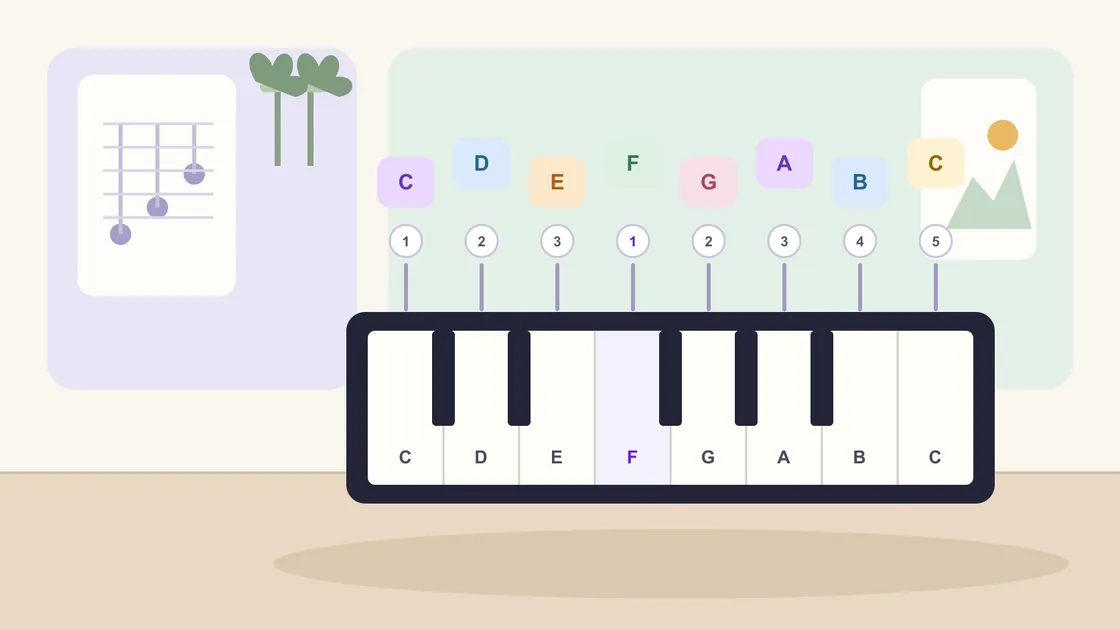
The best first piano scale for beginners is C major because it uses only white keys: C-D-E-F-G-A-B-C. Start with one octave and practise one hand at a time. For the right hand going up, use fingers 1-2-3-1-2-3-4-5. For the left hand going up, use 5-4-3-2-1-3-2-1. Play slowly enough that every note sounds even and your hand stays relaxed. Speed is not the first goal; smooth movement and consistent fingering are.
What Is A Piano Scale?
A piano scale is a sequence of notes played in ascending or descending order. Scales follow a specific pattern of distances between notes, which gives each scale its sound.
When you play a C major scale upward, you start on C and move step by step to the next C:
C-D-E-F-G-A-B-C
When you play it downward, the order reverses:
C-B-A-G-F-E-D-C
The first and last C are one octave apart. If the keyboard pattern still feels unfamiliar, begin with Piano Keys Explained for Beginners.
Why Should Beginners Practise Scales?
Scales are useful when they support real playing. They help beginners:
- learn the geography of the keyboard
- coordinate fingers in a predictable pattern
- practise moving the thumb smoothly
- develop an even tone and rhythm
- recognise note patterns inside songs
- warm up with a short, focused task
Scales are not a test of how fast you can move. A slow, controlled scale is more valuable than a fast, uneven one.
You also do not need to learn every major and minor scale immediately. One carefully practised scale is enough to build the first useful habits.
Start With The C Major Scale
C major is the clearest first scale because it uses no black keys.
The notes are:
| Direction | Notes |
|---|---|
| Up | C-D-E-F-G-A-B-C |
| Down | C-B-A-G-F-E-D-C |
Find C by looking for a group of two black keys. C is the white key immediately to the left. Choose a C near the middle of the keyboard, then play the next seven white keys to the right.
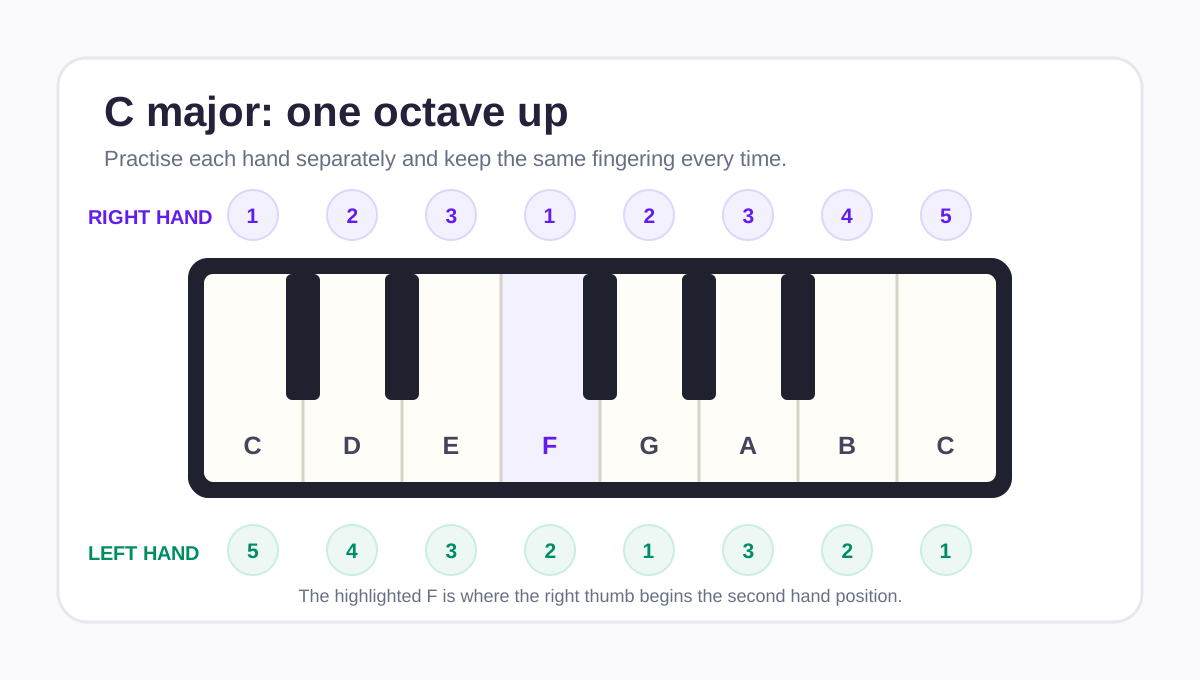
The note pattern is simple. The new skill is moving the hand without running out of fingers.
Piano Finger Numbers
Piano fingering uses numbers instead of finger names:
- 1: thumb
- 2: index finger
- 3: middle finger
- 4: ring finger
- 5: little finger
The numbers are mirrored between the hands. Both thumbs are finger 1, and both little fingers are finger 5.
Fingerings are not arbitrary rules. They help the hand move through more notes than it has fingers while staying balanced and ready for the next note.
Right-Hand C Major Fingering
Place your right thumb on C.
Going Up
Use:
1-2-3-1-2-3-4-5
Play C-D-E with fingers 1-2-3. After E, move the thumb gently under the hand to play F. Continue G-A-B-C with fingers 2-3-4-5.
Think of the thumb movement as a small hand repositioning, not a dramatic twist. Keep the wrist flexible and let the hand travel slightly to the right.
Going Down
Use:
5-4-3-2-1-3-2-1
Play C-B-A-G-F with fingers 5-4-3-2-1. Then move finger 3 over the thumb to play E and finish D-C with fingers 2-1.
Pause between upward and downward practice at first. You do not need to connect both directions immediately.
Left-Hand C Major Fingering
Place your left little finger on C.
Going Up
Use:
5-4-3-2-1-3-2-1
Play C-D-E-F-G with fingers 5-4-3-2-1. Then move finger 3 over the thumb to play A and finish B-C with fingers 2-1.
Going Down
Use:
1-2-3-1-2-3-4-5
Play C-B-A with fingers 1-2-3. Move the thumb under to G, then finish F-E-D-C with fingers 2-3-4-5.
The left hand may feel less natural at first, especially for right-handed beginners. That is normal. Give it separate, slow repetitions rather than expecting both hands to progress at the same speed.
How To Practise Your First Scale
Break the scale into small steps.
- Say the notes. Play C-D-E-F-G-A-B-C with any comfortable fingers.
- Practise the first three notes. Repeat C-D-E with the right hand.
- Add the thumb movement. Play C-D-E-F slowly with 1-2-3-1.
- Finish the octave. Continue to the top C.
- Practise downward separately.
- Repeat with the left hand.
Do not add both hands until each hand can play the scale comfortably on its own. Separate-hand practice is not a shortcut; it is the most direct way to learn the movement accurately.
A Five-Minute Scale Routine
Use this routine at the start of a longer practice session or on its own.
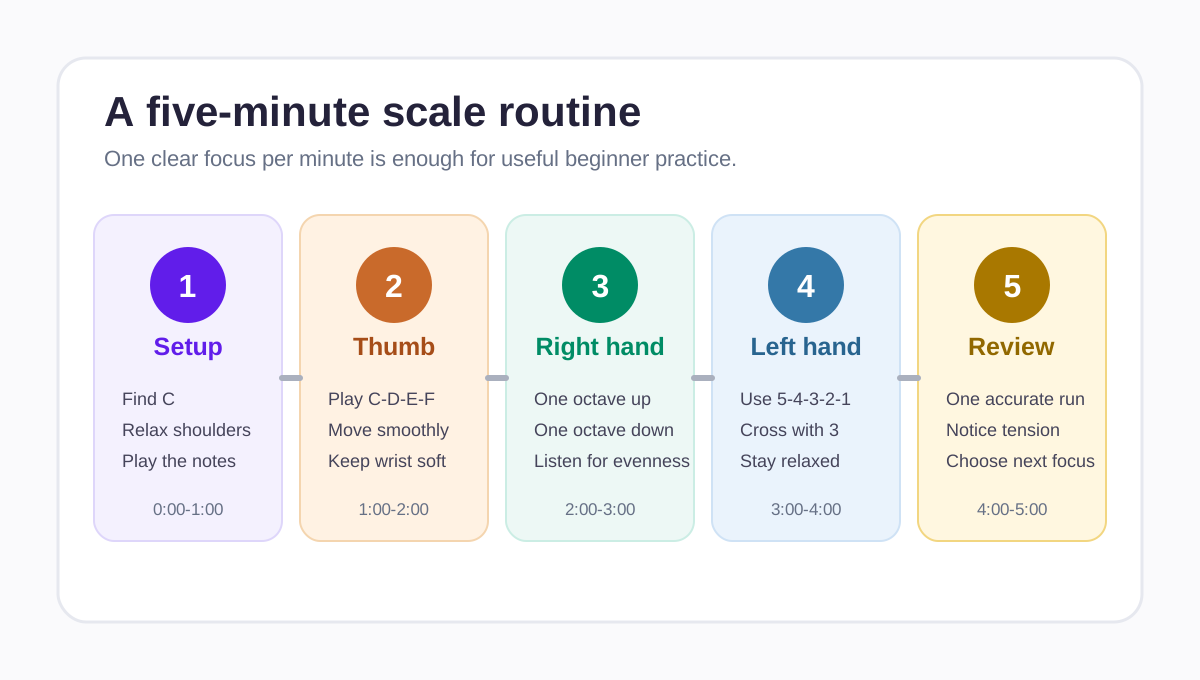
- Minute 1: Find C, check posture, and play the notes without worrying about fingering.
- Minute 2: Practise the right-hand thumb movement slowly.
- Minute 3: Play the full right-hand scale up and down.
- Minute 4: Practise the left hand in the same way.
- Minute 5: Play one final slow repetition with each hand and notice what needs work next time.
Stop and reset if the hand tightens. Several relaxed repetitions are more useful than repeating a tense movement for five minutes.
You can place this inside the 15-Minute Piano Practice Routine for Beginners.
Should Beginners Use A Metronome?
A metronome can help after the notes and fingering are familiar. Start at a comfortable tempo, such as 50 or 60 beats per minute, and play one note per beat.
Use it to check evenness, not to force speed. If you miss notes, change fingers, or tense your hand, slow down or practise without the metronome again.
Increase the tempo only when:
- the fingering stays consistent
- every note sounds clear
- the rhythm is even
- the wrist and hand remain relaxed
An increase of two to five beats per minute is enough.
When Should You Play Scales With Both Hands?
Wait until each hand can play the scale independently without frequent stops.
When you combine the hands:
- Start much slower than your separate-hand tempo.
- Play only the first four notes.
- Check where each hand changes position.
- Add the rest of the octave in small sections.
The hands use different finger numbers at the same time, so this can feel confusing. That does not mean you learned the scale incorrectly. It is a new coordination task.
Both-hands scales are optional in the earliest stage. A beginner gains plenty from accurate separate-hand practice.
Which Piano Scales Should You Learn Next?
After C major feels comfortable, add scales gradually:
- G major: introduces F sharp
- F major: introduces B flat
- D major: introduces F sharp and C sharp
- A minor: uses the same white-key notes as C major in its natural form
G major or F major is usually a sensible next step because each introduces only one black key. Keep using one octave and separate hands before expanding the range.
Do not choose the next scale only because C major is fast. Move on when the C major fingering feels reliable and you understand how the hand shift works.
Common Beginner Scale Mistakes
Changing Fingering Every Time
Inconsistent fingering makes the scale harder to remember. Use the same fingering slowly until it becomes familiar.
Twisting The Wrist
The thumb movement should not force the wrist into a large sideways twist. Let the hand travel along the keyboard and keep the wrist flexible.
Practising Too Fast
Speed can hide uneven notes and rushed finger changes. Slow down until you can hear and control every note.
Lifting Fingers Too High
Large finger movements waste effort and often create tension. Keep the fingertips close to the keys.
Starting With Both Hands
Learning the fingering and coordination simultaneously creates unnecessary difficulty. Build each hand first.
Treating Scales As Mindless Repetition
Listen for even rhythm, balanced volume, and relaxed movement. Each repetition should have a specific focus.
Scales For Adult Beginners And Children
Adult beginners sometimes avoid scales because they seem technical or repetitive. Keep them short and connect them to music. Notice when a song moves through several neighboring notes; that is scale movement in a real piece.
For children, use small goals:
- play the notes in the correct order
- remember one finger change
- keep a steady pulse
- finish with relaxed hands
One or two focused minutes may be enough for a young beginner. Quality matters more than completing a fixed number of repetitions.
tonestro can help beginners practise scales, note patterns, and songs with immediate feedback. Use guided exercises to check pitch and rhythm, but continue watching for physical comfort and consistent fingering at the keyboard.
Related Reading
- Piano Keys Explained for Beginners
- Piano Notes for Beginners
- What Is Middle C on Piano?
- 15-Minute Piano Practice Routine for Beginners
- How to Learn Piano for Beginners
- How to Read Sheet Music for Piano Beginners
FAQ
What piano scale should a beginner learn first?
C major is usually the best first scale because it uses only white keys. Its notes are C-D-E-F-G-A-B-C.
What is the right-hand fingering for C major?
Going up, use 1-2-3-1-2-3-4-5. Going down, use 5-4-3-2-1-3-2-1.
What is the left-hand fingering for C major?
Going up, use 5-4-3-2-1-3-2-1. Going down, use 1-2-3-1-2-3-4-5.
How long should beginners practise scales?
Two to five focused minutes is enough at first. Stop before the movement becomes tense or careless.
Should beginners practise scales every day?
Daily practice can help, but accuracy matters more than frequency alone. A few careful repetitions on most practice days are sufficient.
How fast should a beginner play scales?
Play slowly enough to keep the correct notes, fingering, rhythm, and relaxed movement. If using a metronome, 50 or 60 beats per minute with one note per beat is a reasonable starting point.
Do beginners need to play scales with both hands?
Not immediately. Separate-hand practice builds the notes and fingering first. Combine the hands only when each one feels comfortable alone.
Are scales actually useful for learning songs?
Yes. Many melodies and accompaniment patterns use neighboring notes or fragments of scales. Scale practice makes those patterns easier to recognise and play.
Last updated